Begin with where you are standing
Before searching for a constellation, take in the horizon. Notice nearby buildings, hills, trees, or other fixed landmarks and identify the direction you are facing using a compass or a trusted map. A compass helps with orientation, but it does not tell you which stars are visible: visibility changes with season, time, location, and obstructions. Avoid relying on a single phone screen if its light is affecting your night vision.
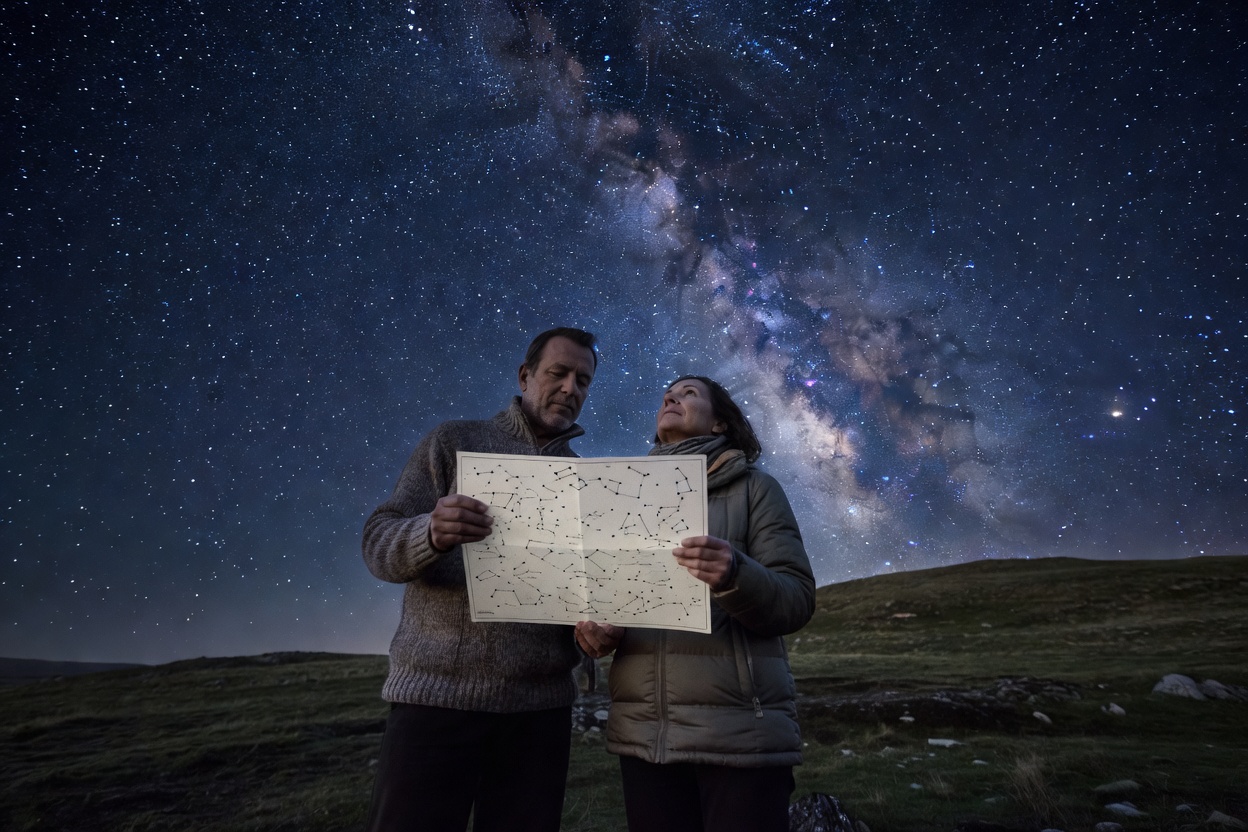
Sky maps are usually drawn as if the sky were a dome above you. The map’s orientation can feel unintuitive at first, because a chart held overhead may need to be turned to match the direction you face. Check the map instructions and turn the chart until its horizon direction aligns with yours. Start with a large, recognizable outline rather than a tiny cluster of points.
Use one anchor at a time
Pick a bright star or a familiar group that is currently visible from your location. From that anchor, trace a short line or simple shape. Do not worry if the pattern you see looks different from the picture: stars vary in brightness, and light pollution can hide dimmer ones. Many beginners find it easier to identify a pattern with a friend pointing out one star at a time than by scanning a chart full of labels.
Constellations are named regions and traditional patterns, not necessarily close-knit families of stars in space. The stars in a familiar outline can be at very different distances from Earth. The outline is a human way of organizing what appears together from our viewpoint. That makes patterns memorable without requiring the stars to be physically connected.
Let the seasons change your view
As Earth orbits the Sun, the night side of our planet faces different directions through the year. As a result, many familiar star patterns are seasonal: some are prominent in evening skies at one time of year and absent from view at another. The exact schedule depends on latitude and observing time. A current monthly sky guide, local planetarium resource, or astronomy society can help you check what is visible where you are.
The Moon also changes the experience. A bright Moon can wash out faint stars, but it is an excellent target in its own right. On darker nights, more faint stars may appear, although the view will still depend on local artificial light, weather, and your horizon. Instead of treating moonlight as a failed night, choose an observation that suits the conditions.
Build a personal map
- Write down one pattern you found and the direction you faced.
- Sketch only the brightest points; a rough drawing is enough.
- Return at a similar time on another clear night and compare.
- Use a reliable chart for your date and location, not a generic fixed diagram.
- Ask a local astronomy group about safe public observing opportunities.
Over time, a few anchor patterns can help you find other areas of the sky. This is a gradual skill, not a test of memory. It is normal to lose your place when clouds move in or when you change observing locations. Find the broad outline again and rebuild from there.
Notice more than names
Identifying a constellation is one way to pay attention, but it is not the only one. You can notice the apparent contrast between a bright star and its neighbors, watch the Moon move relative to a rooftop across the evening, or compare how the sky looks from a suburban street and a darker park. If you use a chart or an app, treat it as a guide rather than an answer key. The aim is a more confident relationship with the sky you can actually see.
For a comfortable first session, see the beginner observing plan. If you would rather learn alongside others, try planning a shared night.